

geometry dash wave
Introduction
Geometry Dash is one of the most popular rhythm-based platform games ever created. Developed by RobTop Games, the game combines music, timing, precision, and creativity into a unique gaming experience. Since its release in 2013, Geometry Dash has attracted millions of players around the world. One of the key reasons for its success is the variety of game modes available. Players control different forms such as the cube, ship, ball, UFO, robot, spider, and wave. Among all these modes, the wave is often considered the most difficult, skill-based, and iconic.
The wave mode has become a symbol of advanced gameplay in Geometry Dash. It challenges players to navigate through tight spaces at high speeds while maintaining perfect control. Many of the game's hardest levels rely heavily on wave sections because they test precision, reaction time, and consistency more than any other game mode. For both casual players and top-level competitors, mastering the wave is a significant milestone.
This geometry dash wave essay explores the history, mechanics, challenges, importance, and influence of the wave mode in Geometry Dash. It examines why the wave has become one of the most beloved and feared aspects of the game and how it has shaped the Geometry Dash community.
The Origin of the Wave Mode
The wave mode was introduced in Geometry Dash Update 1.9. Before its introduction, players were already familiar with several game modes that offered different movement mechanics. However, many players wanted a new challenge that would require a different set of skills.
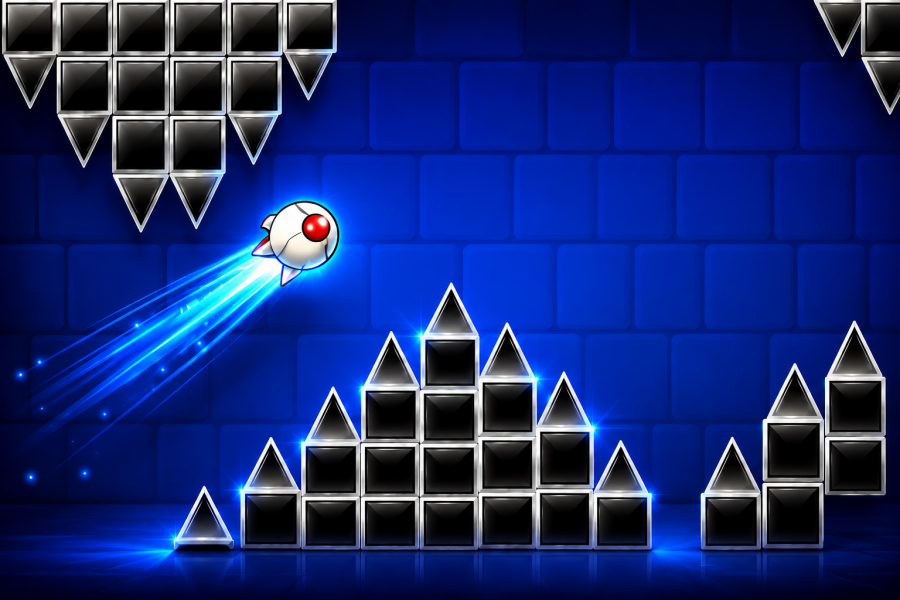
When the wave was first released, it immediately stood out from the other forms. Unlike the cube, which jumps over obstacles, or the ship, which flies smoothly through the air, the wave moves in a zigzag pattern. The player controls the wave by holding the screen or mouse button to move upward diagonally and releasing it to move downward diagonally. This creates a sharp, triangular movement pattern that resembles a wave, giving the mode its name.
The introduction of the wave added a new level of complexity to Geometry Dash. Levels could now include extremely narrow passages that demanded precise timing and control. The wave quickly became a favorite among experienced players because it rewarded skill and practice more directly than many other modes.
Understanding the Mechanics
At first glance, the wave may seem simple. The controls involve only holding and releasing a button. However, beneath this simplicity lies a surprisingly deep mechanic that requires extensive practice to master.
When the player presses and holds, the wave travels upward at a constant diagonal angle. When the button is released, it immediately changes direction and travels downward at the same angle. Unlike the ship, which accelerates gradually, the wave responds instantly to player input. This instant response makes it highly precise but also unforgiving.
The movement system creates several important gameplay techniques. Players must learn how to make small adjustments, often called micro-clicks, to navigate tight spaces. They must also understand longer holds for wider movements and develop muscle memory for different obstacle patterns.
The difficulty increases further when speed changes are introduced. Geometry Dash levels often modify the speed of gameplay, causing the wave to move much faster than normal. At higher speeds, players have less time to react and must rely heavily on instinct and experience.
Because every movement directly reflects the player's input, mistakes are immediately noticeable. A single incorrect click can cause the wave to crash into a wall, ending the attempt. This makes consistency a critical skill for successful wave gameplay.



To comment please sign in or register.